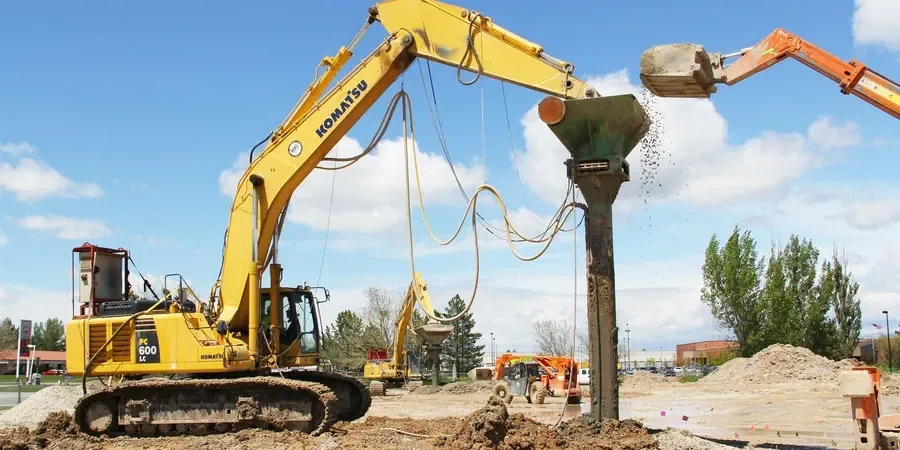
Ground improvement in Bendigo is not merely a construction preference—it is an essential engineering discipline that transforms marginal or problematic soils into reliable founding strata. This category encompasses a suite of advanced geotechnical techniques designed to increase bearing capacity, mitigate settlement, accelerate consolidation, and reduce liquefaction potential. From the reactive clay plains to the gold-bearing alluvial deposits that underpin much of the city, Bendigo's subsurface conditions demand tailored improvement strategies. Whether you are developing a multi-storey structure in the CBD, constructing a stormwater basin in Epsom, or extending industrial warehousing in East Bendigo, the performance of your foundation system hinges on a thorough understanding of how to modify the ground beneath it.
Bendigo's geological setting is dominated by Ordovician turbidites and the deeply weathered products of the Bendigo Goldfield, overlain by Quaternary clays, silts, and sands. Much of the urban area is characterised by highly reactive clay soils that undergo significant volume changes with seasonal moisture fluctuations, posing a persistent threat to slabs and pavements. In other zones, particularly along the Bendigo Creek corridor and in former mining districts, uncontrolled fill, mine tailings, and loose alluvial sands introduce risks of differential settlement and, in a seismic event, cyclic mobility. These local conditions make a compelling case for rigorous site investigation and the application of targeted ground improvement methods rather than relying solely on deep foundations or over-excavation.
Australian practice for ground improvement is governed by a framework of standards and guidelines that ensure designs are robust, verifiable, and suited to local conditions. AS 2870 (Residential slabs and footings) remains the primary reference for addressing reactive clay sites, while AS 2159 (Piling—Design and installation) and AS 4678 (Earth-retaining structures) inform aspects of ground treatment that interface with structural elements. For dynamic compaction, dynamic compaction design must adhere to the vibration and settlement monitoring criteria outlined in AS 2436 and relevant EPA Victoria guidelines. Similarly, deep soil mixing (DSM) design is executed in accordance with the FHWA design manual and Australian best-practice documents, with verification testing aligned to AS 3798 for earthworks control. When drainage-driven solutions are required, prefabricated vertical drain (PVD) design follows Barron's consolidation theory and is validated against the settlement tolerances of AS 2870 and project-specific performance specifications.
The types of projects that demand ground improvement in Bendigo span residential subdivisions on reactive clays, where geogrid specification and lime stabilisation improve pavement subgrades; commercial developments that encounter buried mine workings and require grouting design to fill voids and stabilise the ground; and infrastructure corridors where deep soft soils necessitate preloading with PVDs or vacuum consolidation. In the city's expanding industrial precincts, vibrocompaction design is frequently employed to densify loose granular fills, while geotechnical drainage design underpins the long-term performance of retaining walls and basement slabs. Each intervention is selected based on a careful balance of ground conditions, structural loads, programme constraints, and environmental considerations, ensuring that the improvement strategy is both technically sound and commercially viable.
For Bendigo's reactive clays, lime or cement stabilisation, deep soil mixing, and moisture control via geotechnical drainage are commonly employed. These methods reduce shrink-swell potential and improve bearing capacity. The choice depends on plasticity index, depth of reactive zone, and structural sensitivity, with AS 2870 providing classification and design guidance for residential and light commercial slabs.
A comprehensive geotechnical investigation will reveal whether loose sands, soft clays, uncontrolled fill, or mine workings are present. If settlement analyses exceed tolerable limits or bearing capacity is inadequate, ground improvement—such as dynamic compaction, grouting, or PVDs—can often treat the mass soil volume more economically than piling, especially for large-footprint structures.
Key standards include AS 2870 for reactive clay sites, AS 3798 for earthworks control and verification, AS 2159 for piled elements interacting with treated ground, and AS 4678 for retaining structures. Vibration-intensive methods like dynamic compaction must also comply with AS 2436 and EPA Victoria's noise and vibration guidelines to protect adjacent structures.
Yes, grouting—particularly compaction and permeation grouting—is routinely used to fill voids and stabilise fractured ground above abandoned gold mine workings. Combined with targeted drilling and geophysical surveys, a designed grouting programme can mitigate collapse risk and provide a uniform bearing stratum, allowing safe development over historically mined areas.